
We have entered an era where raw intelligence is essentially free, yet operational stability is agonizingly scarce. For the past two years, C-level executives have rushed to populate their tech stacks with every available frontier model, specialised coding assistant, and autonomous agent framework. The prevailing assumption was simple: more tools equal more output. But as enterprises cross into the mid-2026 operational landscape, a harsh reality has set in. Companies are not suffering from a lack of intelligence; they are drowning in infrastructural chaos.
Introduction: The Infrastructure Debt of the Agentic Era
The root cause of this turbulence is the Missing Control Layer. When an organization deploys dozens of disconnected AI agents without a unified orchestration architecture, it creates what we term “Fragmentation Debt.” Agents hallucinate conflicting directives, API rate limits collide, token spend spirals out of control, and human operators find themselves acting as manual switchboards for automated systems. This is the “GenAI Paradox”: we have spent billions on models that can think, yet we still lack the systems to make them work.
Solving this challenge requires a fundamental shift in executive mindset. We must move away from the frantic accumulation of standalone tools and embrace a rigorous doctrine of Systems over Tools. In this deep-dive exploration, we examine why the control layer is the most critical missing piece in modern AI deployment, how to audit your own operational architecture, and how establishing a sovereign orchestration plane transforms autonomous agents from an unpredictable liability into a predictable, high-ROI engine.
1. The Anatomy of Fragmentation Debt: Why Standalone Tools Fail
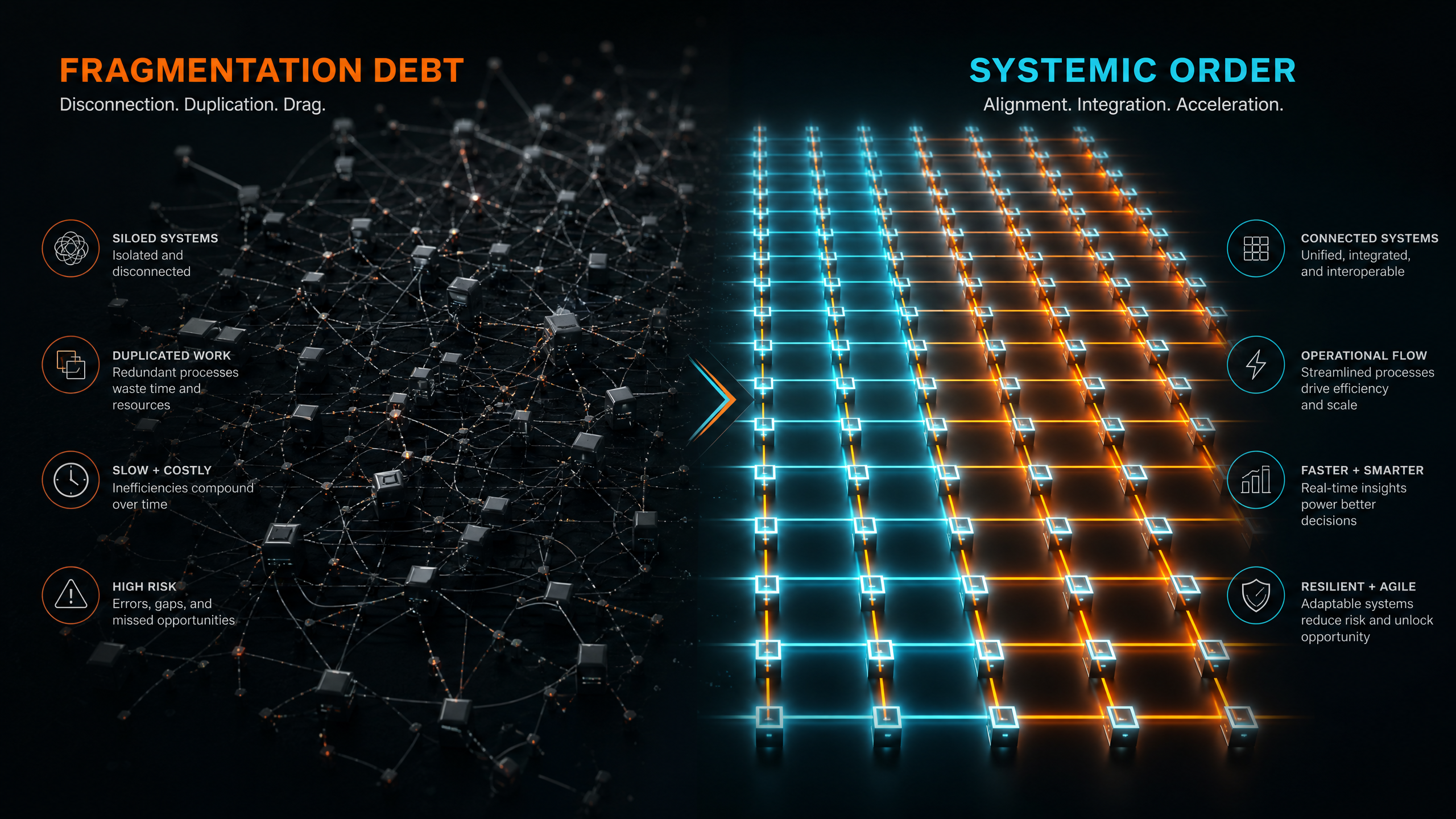
To understand the necessity of a control layer, one must first diagnose the disease currently plaguing enterprise IT budgets: Fragmentation Debt. When organizations adopt AI tools piecemeal—purchasing marketing agents here, customer support bots there, and developer copilots everywhere else—they establish isolated pockets of automation that cannot talk to one another.
In game development and high-stakes production pipelines, this is equivalent to having a rendering engine that cannot communicate with the physics simulation. The visual assets look stunning, but they fall straight through the floor because there is no mediating framework governing their interaction.
The Three Symptoms of Fragmentation Debt
1. Contextual Isolation and “Contextual Drift”
Each standalone agent operates within its own myopic window of prompt context. When Customer Support Agent A hands off a ticket to Billing Agent B, critical context is lost in translation. This leads to “Contextual Drift,” where the intent of the original user request is slowly eroded as it passes through multiple uncoordinated systems. Eventually, the human supervisor must step in and manually bridge the gap, negating the time-savings of the automation.
2. Unmanaged Token Burn and the “Bill Shock” Phenomenon
Without a centralized gateway to monitor and route requests based on task complexity, teams often route simple classification tasks to massive, expensive reasoning models. This is like using a supercomputer to calculate a restaurant tip. In the absence of a control layer that can perform intelligent “Model Hedging,” enterprises are hit with catastrophic monthly billing shocks that destroy the ROI of their AI initiatives.
3. Shadow Automation and the Governance Gap
Department heads, frustrated by the slow pace of centralized IT, often deploy their own rogue agents. This creates “Shadow Automation”—a massive governance gap where sensitive corporate data is being fed into external models without security oversight. Under strict frameworks like the EU AI Act of 2026, these unmanaged agents represent a severe regulatory and fiduciary liability.
The C-suite remedy for Fragmentation Debt is not another software subscription; it is architectural consolidation. You do not need more tools. You need a connective tissue that binds your existing models into a coherent, self-governing assembly.
2. Defining the Control Layer: The Enterprise Operating System for AI
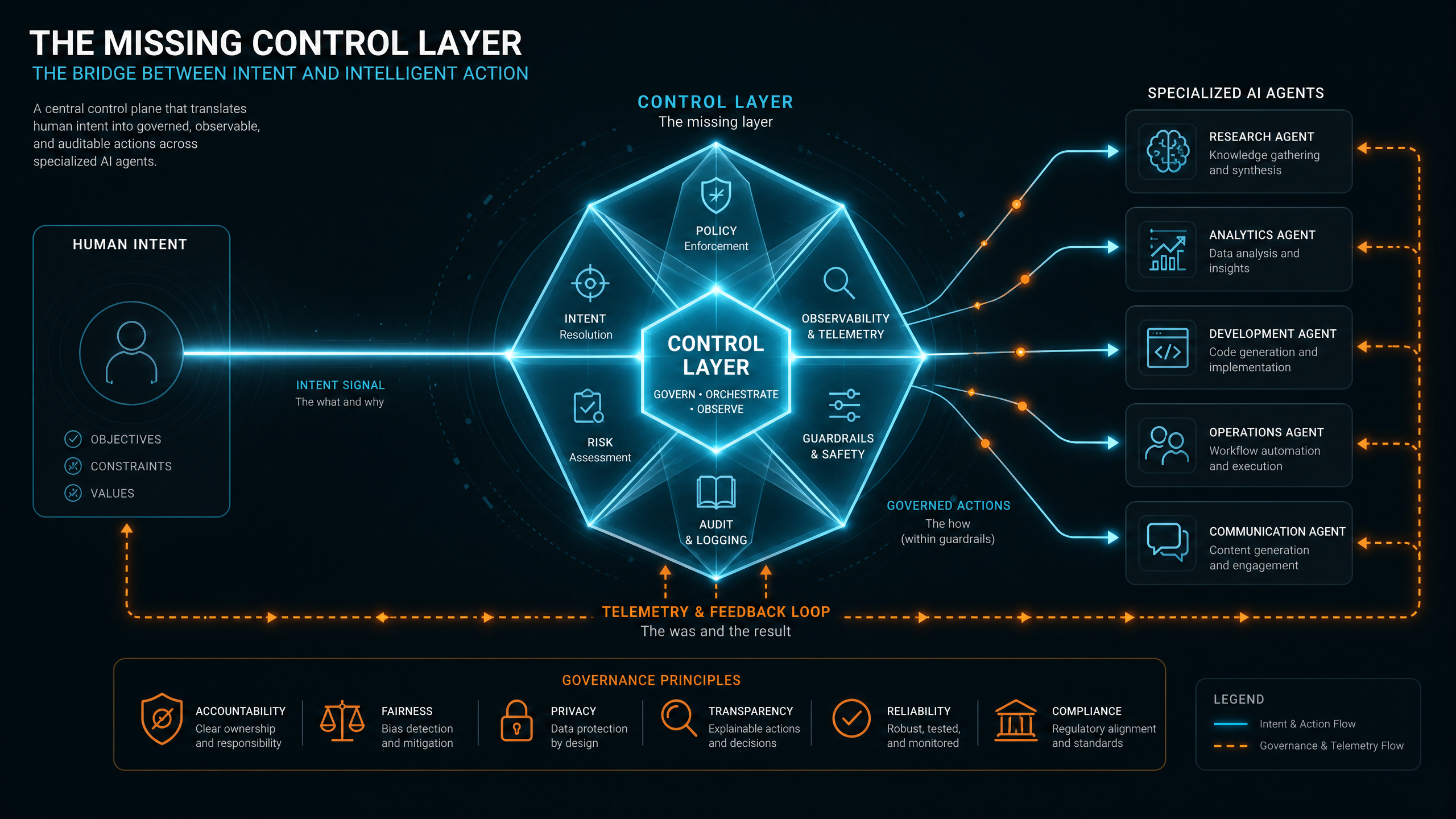
What exactly is the Control Layer? In technical terms, it is the middleware that sits between raw foundational model APIs and your enterprise business systems. It is the “brain” that coordinates the “muscles.” A robust control layer is responsible for four foundational pillars: Decomposition, Routing, Governance, and Telemetry.
Decomposition and Intelligent Routing
A true control layer takes a complex, multi-step executive directive—such as “Perform a competitive analysis of the APAC manufacturing sector”—and decomposes it into granular, sub-task workflows. It determines which sub-tasks require the lightning-fast execution of a lightweight model and which require the deep, deliberative reasoning of a frontier engine. By intelligently routing requests, the control layer ensures that capital is allocated efficiently across your entire digital workforce.
Memory Management and State Persistence
One of the most significant “missing pieces” in standalone agents is memory. Most models are stateless; they forget who you are the moment the session ends. A control layer provides State Persistence, maintaining a “Long-Term Memory Mesh” that allows agents to remember previous decisions, user preferences, and historical data across different departments. This turns your AI from a series of one-off conversations into a continuous, evolving knowledge base.
Governance, Identity, and “Fiduciary-Grade” Security
Just as human employees require security clearances, RBAC (Role-Based Access Control), and compliance training, autonomous agents require strict Agent Identity. A control layer establishes cryptographic identities for every agent in your mesh. This ensures that a customer-facing support bot never possesses the database privileges reserved for executive financial agents. This is the foundation of “Fiduciary-Grade AI”—systems that can be trusted with the keys to the kingdom.
Real-Time Telemetry and the “Kill Switch”
Perhaps the most urgent mandate of the control layer is observability. In an autonomous environment, a runaway loop or a recursive prompt injection can drain API credits and execute unintended database writes in seconds. A robust control layer provides an instantaneous Kill Switch—a centralized circuit breaker that halts anomalous agentic behavior before it impacts the bottom line. It provides real-time telemetry on every token spent and every decision made, allowing for the first time a true audit trail of AI activity.
3. The Producer’s Edge: Treating Agents as Digital Employees
My background in high-stakes game production taught me a fundamental truth that applies directly to the agentic era: Scale is a function of clear job descriptions, not brute force. In production, you don’t just “hire people”; you build a pipeline where each role has a specific input and a specific output.
When executives treat AI agents as magical black boxes that will “figure things out,” failure is guaranteed. Conversely, when you treat agents as digital employees with specific Standard Operating Procedures (SOPs), clear boundaries, and measurable Key Performance Indicators (KPIs), your operations transform.
Implementing the Digital Org Chart
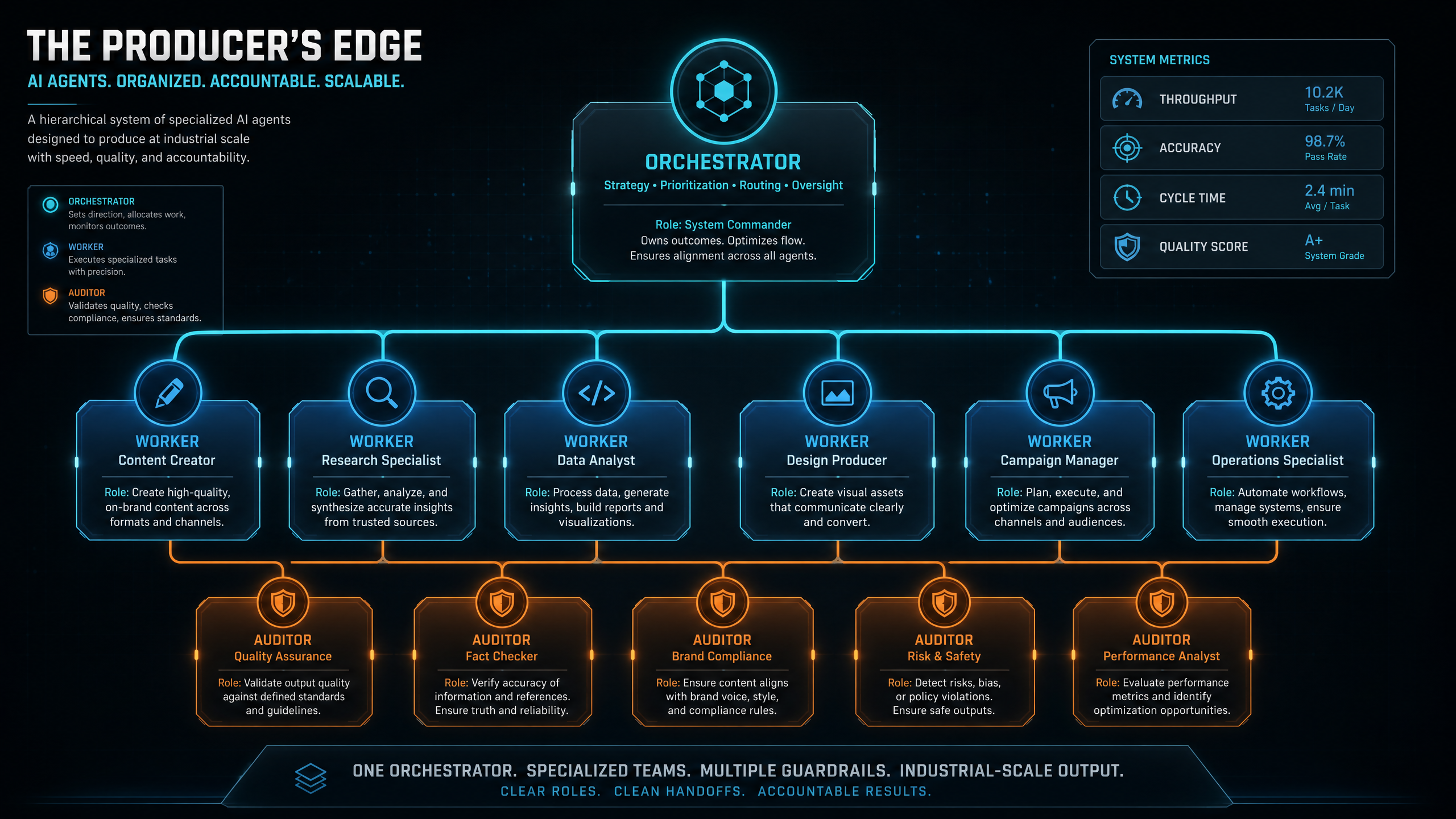
In an “Electric Obsidian” architecture, your agentic stack is structured like an organizational chart, moving from “Activity” to “Orchestration”:
- The Orchestrator (Chief of Staff): This is the top-level agent that receives high-level human intent. It does not “do” the work; it decomposes the objective and delegates sub-tasks down the chain to specialized workers.
- Specialist Workers (Domain Agents): These are narrow, high-precision agents. You might have a “Legal Review Agent,” a “Python Debugging Agent,” and a “Market Research Agent.” They execute their specific SOPs with 99% accuracy because they are not being asked to be generalists.
- The Auditor (Compliance Officer): This is the most overlooked role. The Auditor agent continuously reviews the output logs of worker agents against regulatory frameworks and internal safety guidelines. It acts as the final “Human-on-the-Loop” filter before any action is taken in the real world.
This hierarchical division of labor removes the cognitive burden from human operators. You are no longer a reactive micromanager checking every prompt; you are a proactive Context Architect designing the system that produces the results.
4. The Geopolitics of Orchestration: Sovereignty and Compliance
As we move further into 2026, the control layer is no longer just a technical preference; it is a geopolitical necessity. With the full enforcement of the EU AI Act and the rise of sovereign AI mandates in regions like the Middle East and Asia, C-suite leaders are facing a “Sovereignty Crisis.”
The Vendor Lock-In Trap
If your entire agentic workflow is built inside a single vendor’s “walled garden,” you are at the mercy of their pricing, their downtime, and their regulatory compliance (or lack thereof). A neutral control layer provides Vendor Agility. It allows you to swap out an underlying model in minutes if a competitor releases a more efficient engine or if your primary provider faces a regional outage.
Data Sovereignty and the “Local Mesh”
Enterprises are increasingly moving toward “Local Meshes”—orchestration layers that run on private cloud infrastructure. This allows agents to process sensitive data without that data ever leaving the corporate perimeter. The control layer acts as the border patrol, ensuring that only anonymized or “scrubbed” data is sent to external frontier models for reasoning, while the raw “Crown Jewels” remain securely on-site.
5. From Activity to Outcomes: Measuring the ROI of Orchestration
The final hurdle in solving the missing control layer is the “ROI Awakening.” For too long, AI success was measured by vanity metrics: “How many tokens did we generate?” or “How many employees are using the chatbot?” In 2026, these metrics are irrelevant.
The New Executive KPIs for AI
A robust control layer allows you to track the only metrics that matter to the P&L:
- Cycle Time Reduction: How much faster are we completing a core business process (e.g., from customer inquiry to resolution)?
- The 11% Production Barrier: What percentage of our agentic projects have moved from “prototype” to “daily production”? (Currently, the industry average is a dismal 11%—the control layer is designed to double this).
- Autonomous Accuracy: What is the rate of “Successful Autonomous Completion” without human intervention?
- Token Efficiency: What is the cost-per-outcome?
By tying orchestration directly to these KPIs, the C-suite can finally justify the massive capital expenditures required for AI transformation. We are moving from “AI as a Cost Center” to “AI as an Outcome Engine.”
6. Building the 2026 Resilience Audit: Your Action Plan
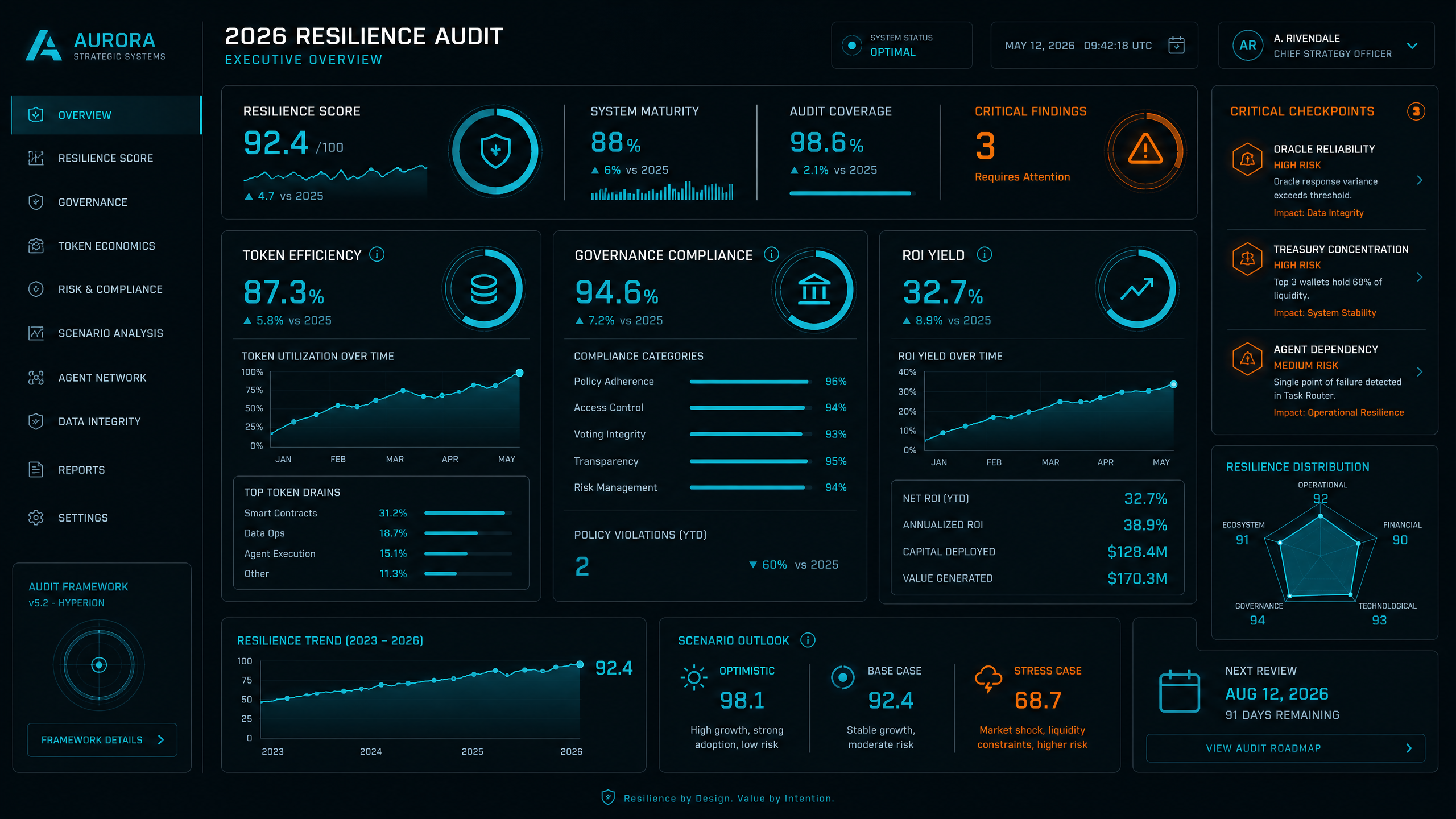
Moving from experimental AI to structural production requires a methodical audit of your current operational posture. Below is the 2026 Resilience Audit, a four-step framework designed to help C-level leaders eliminate fragmentation debt and establish their control layer.
Step 1: The Inventory and De-escalation Audit
Catalog every AI subscription, API key, and deployed bot currently active across your organization. Categorize them into mission-critical production systems and experimental tools. Ruthlessly cut redundant tools that lack native integration capabilities or compliance guardrails. If it can’t be orchestrated, it shouldn’t be in your stack.
Step 2: Protocol Standardization (Embracing MCP and A2A)
Audit your technical infrastructure to ensure compatibility with modern interoperability standards such as the Model Context Protocol (MCP) and Agent-to-Agent (A2A) protocols. Your agents must be able to share memory and state dynamically without custom point-to-point API spaghetti code. Standardization is the only path to scale.
Step 3: Establishing the Human-on-the-Loop Threshold
Define clear decision boundaries. Establish automated execution tiers for low-risk operational tasks while enforcing mandatory “Human-on-the-Loop” checkpoints for financial transactions, public communications, and client-facing deliverables. You are not removing the human; you are elevating them to the role of Systems Governor.
Step 4: Continuous Cost and Token Governance
Implement a centralized AI gateway that tracks token consumption per workflow, department, and project. Tie AI spending directly to business outcomes, ensuring that every dollar spent on compute yields a measurable return on investment. Implement automated “Circuit Breakers” for any workflow that exceeds its daily token budget.
Conclusion: The Era of the Owner-Architect
The transition from the prompt-engineering frenzy of previous years to the mature, industrialized agentic era of 2026 is the defining challenge for modern leadership. Those who continue to chase every new chatbot release will remain trapped in pilot purgatory, bleeding capital on uncoordinated tooling. They will suffer from the “Complexity Debt” that makes their organizations slower and less resilient.
Those who embrace Systems over Tools—who invest the time to build a robust, secure, and observable control layer—will unlock the true promise of agentic orchestration: exponential leverage without administrative chaos. They will move from being “Users” of AI to being Architects of Intelligence.
The infrastructure debt is real, but so is the opportunity. By stepping into the role of the Owner-Architect, you are not merely adopting software; you are engineering the autonomous engine that will drive your enterprise forward into the next decade. The control layer is the missing piece. It is time to build it.